Service
Inheritance Tax Planning
The long-term-residence question, addressed before it is settled.
Who Richard advises
Richard advises people from organisations like these





Employer information is provided by clients during the consultation process and is not independently verified. Logos shown are trademarks of their respective owners and do not imply endorsement of Richard Knight or Business Class Asia.
Who this is for
Who this service is for
- 01
Long-term British expats
Resident in Thailand for years or decades and assuming, often wrongly, that UK inheritance tax no longer applies to them.
- 02
Holders of a global estate
Assets across the UK, Thailand and elsewhere, exposed to UK IHT on the worldwide estate if a UK long-term resident under the post-April-2025 test.
- 03
People sold an IHT product
Were placed in a structure marketed to reduce inheritance tax and want a conflict-free view of whether it works.
What's involved
What's actually involved
A British expat may spend decades in Thailand and still die within the scope of UK inheritance tax. That single fact can determine whether HMRC taxes a worldwide estate at 40%, or whether overseas assets remain outside the UK inheritance tax regime. The rules changed significantly from April 2025, replacing much of the previous domicile framework with a long-term residence test.
The work is to establish the position honestly, plan around the residence and gifting rules in good time, and avoid structures sold on fear that rarely withstand scrutiny.
Long-term residence decides almost everything
From 6 April 2025, the scope of UK inheritance tax follows long-term residence, not domicile. Broadly, ten of the previous twenty UK tax years of residence brings the worldwide estate into scope, and the exposure can persist for several years after you leave the UK.
Diagnosing where you genuinely sit under that test is the first task. Most of the value is in being honest about it early rather than finding it out through the estate.
Planning in time, not in fear
The seven-year clock on lifetime gifts only helps if it is started in good time, and it sits alongside, not inside, the residence test. The structures sold on fear rarely survive scrutiny, the work is the plan that does, made while there is still time for it to work.
Common mistakes
Common mistakes to avoid
- 01
Assuming leaving the UK ended the exposure
Long-term-resident status, not your current address, decides the inheritance-tax scope. Treating departure as an automatic exit is the single most expensive inheritance-tax misconception expats hold.
- 02
Buying a structure sold on fear
Many IHT products are marketed on anxiety and do not survive HMRC scrutiny. The plan has to stand up, not just reassure.
- 03
Starting the clock too late
Lifetime-gift relief depends on surviving seven years. Left to the last decade, the most effective tool is often unavailable.
How the practice works
Three conversations before any commitment
A measured introduction, a written plan, and a clear engagement. No long sales process. No pressure on the first call. You leave the first meeting with a clearer view of what is in front of you, whether or not the work proceeds.
- 01
An introduction
Thirty minutes by video, or in person at the Bangkok, Hua Hin or Pattaya office. A discussion of your situation, your concerns, and what the years ahead are intended to look like. Rough figures are sufficient. No documents required in advance.
- 02
A written plan
A second meeting where the work is appropriate for both parties. A written summary of the plan, the moves in priority order, the realistic timeline, and the cost in plain numbers.
- 03
An engagement, in writing
A written engagement letter that sets out how I am paid, commission on what is arranged and a fee on what is managed, with every figure and what it pays, before you proceed. Either party may end the engagement at any time. Custody arrangements remain in place regardless.
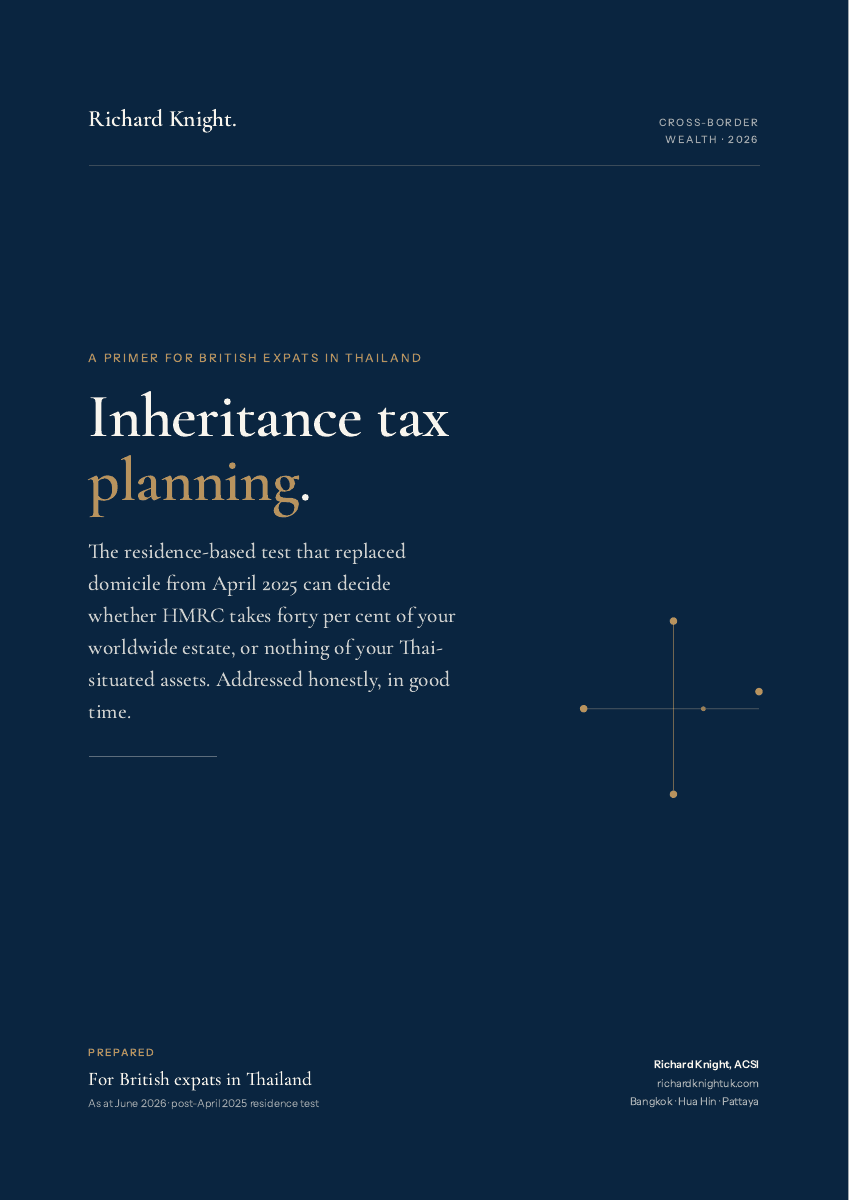
Free guide
Inheritance tax planning for British expats
Since April 2025 a residence test, not domicile, decides whether UK inheritance tax reaches your worldwide estate or only UK assets. Addressed in good time.
What is inside
- The long-term-residence test that replaced domicile
- What is in scope: UK-situated versus worldwide
- Lifetime gifting and the seven-year clock
- The structures sold on fear, and what survives scrutiny
Plain English, nothing to sign. Useful even if you never get in touch.
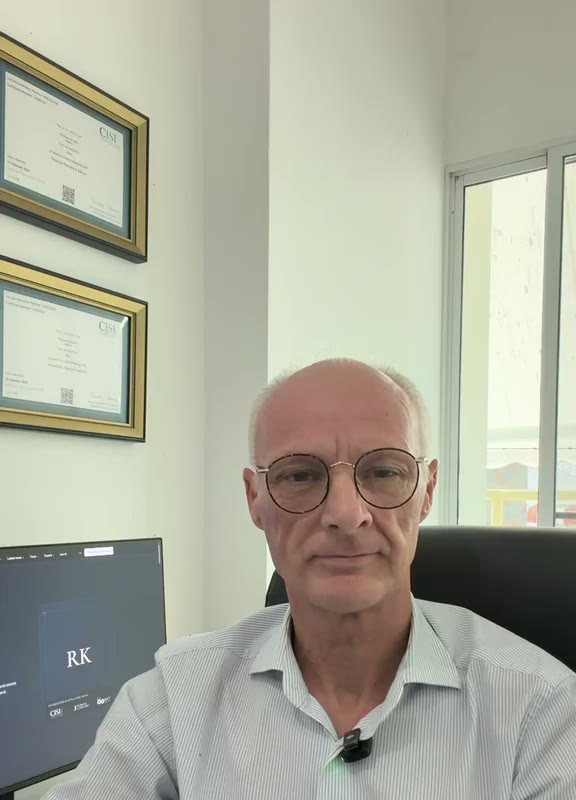
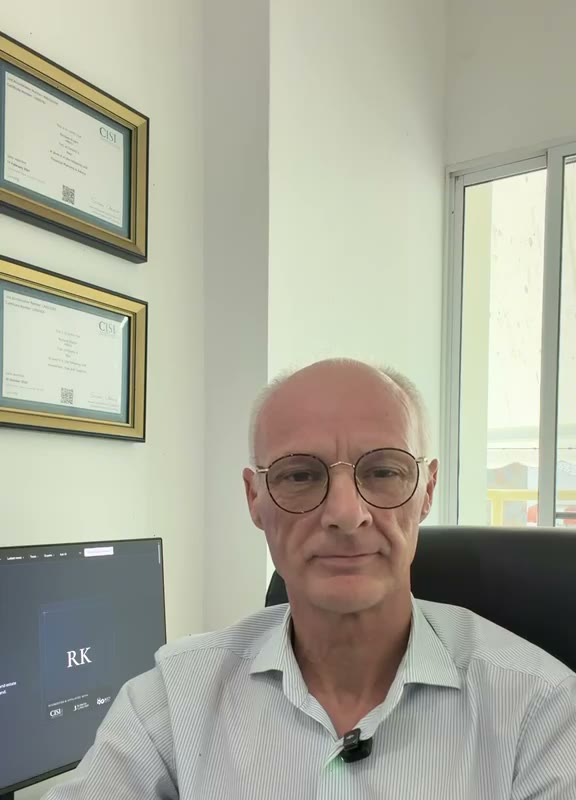
The advisor
Richard Knight
Richard Knight is a British national with fifteen years' experience in private wealth management, advising internationally mobile clients across Asia, Europe and beyond. Based in Thailand, he works with expatriates and international families navigating the complexities of cross-border wealth, retirement and estate planning.
The practice is built on first-hand experience of international relocation and long-term expatriate life, rather than a purely theoretical understanding of it.
He is an Associate Member of the UK's Chartered Institute for Securities & Investment (ACSI) and holds CISI qualifications in Financial Planning and Investments.
He also serves as Vice Chair of the British Chamber of Commerce Thailand in Hua Hin, supporting the local business and expatriate community.
Richard maintains a deliberately limited client base, focusing on conservative, long-term planning for people who value clarity, stability and peace of mind over unnecessary risk.
“Richard works in finance business for many years and his recommendations are reliable and efficient. He is very attentive to the clients and help them to come to the most beneficial solution. Having Richard as your personal finance consultant you can feel secure for your future.”
“Richard is reliable person, with good knowledge of the products that he propose to clients. He want client to understand the process and he cares of the client future.”
“Richard is a great and reliable service provider.”
Fees and what to expect
What it costs, and how I'm paid
I am paid through commission on the products arranged and an ongoing fee on the assets managed. Every cost, and what it pays, is set out in writing before you decide.
You may ask what any recommendation pays me, and the figures that apply are agreed in writing in the engagement letter before you proceed.
A first 30-minute consultation costs nothing and obliges you to nothing.
Client assets are held by an appointed trustee or a regulated platform, never by me.
Questions
Questions about this
Go deeper
Try the tool
Try the tool
Where your domicile, assets and beneficiaries cross borders, and the questions that raises. A guide, not advice.
Begin a conversation
Thirty minutes, by video or in person at the Bangkok, Hua Hin or Pattaya office. Free, and without obligation. You leave with a clearer view of what is in front of you, whether or not the work proceeds.
Book a meeting
Choose a time that suits you
Thirty minutes with Richard Knight, ACSI directly. By video, phone, or in person. No obligation.