Service
Double Tax Agreements
Which country gets to tax it, settled before it is taxed twice.
Who Richard advises
Richard advises people from organisations like these





Employer information is provided by clients during the consultation process and is not independently verified. Logos shown are trademarks of their respective owners and do not imply endorsement of Richard Knight or Business Class Asia.
Who this is for
Who this service is for
- 01
Thai tax residents with UK or overseas income
180+ days a year in Thailand, with pensions, salary or investment income arriving from abroad, unsure whether it is taxed here, there, or both.
- 02
Americans filing on both sides
A US filing obligation that never ends, plus a Thai position, and a need for the treaty read so the same income is not taxed twice.
- 03
People told the treaty covers it
Assured a double tax agreement protects them, but never shown, in writing, how the relief is actually claimed.
What's involved
What's actually involved
A double tax agreement is the treaty between Thailand and another country that decides which of them may tax a given type of income, and which must give credit for tax already paid. Thailand has agreements with the United Kingdom, the United States and many other countries, and they do not all work the same way.
Relief is rarely automatic. It usually turns on residence, the type of income, where it arises, and how and when it is remitted, and it generally has to be claimed correctly rather than assumed.
The work here is to establish what the relevant agreement says for your circumstances, line it up against the 2024 Thai remittance position, and make sure relief is claimed properly so the same income is not taxed twice. Where specialist filing in either country is needed, that is coordinated, not improvised.
Residence decides which treaty applies
Treaty relief turns on tax residence and the type of income, not on nationality or where the money started. The first task is establishing where you are resident for the year in question, on both sides, because that determines which article of which agreement governs each part of your income.
Thai tax residence, 180 days or more in a calendar year, and the 2024 remittance change are read together with the treaty, not separately.
Relief is claimed, not assumed
A double tax agreement does not apply itself. A credit for foreign tax, an exemption, or a reduced rate usually has to be claimed, with the right evidence, in the right return. Assuming the treaty quietly handles it is the common and expensive mistake.
Common mistakes
Common mistakes to avoid
- 01
Assuming nationality decides it
Treaty relief follows tax residence and the type of income, not the passport. Reading it off nationality is where the double charge usually starts.
- 02
Treating relief as automatic
Most relief has to be claimed, with evidence, in a specific return. Left unclaimed, the agreement does not help and the income is simply taxed twice.
- 03
Reading the treaty without the 2024 remittance rule
The Thai remittance position and the treaty interact. A conclusion drawn from the agreement alone can be wrong once remittance timing is in view.
How the practice works
Three conversations before any commitment
A measured introduction, a written plan, and a clear engagement. No long sales process. No pressure on the first call. You leave the first meeting with a clearer view of what is in front of you, whether or not the work proceeds.
- 01
An introduction
Thirty minutes by video, or in person at the Bangkok, Hua Hin or Pattaya office. A discussion of your situation, your concerns, and what the years ahead are intended to look like. Rough figures are sufficient. No documents required in advance.
- 02
A written plan
A second meeting where the work is appropriate for both parties. A written summary of the plan, the moves in priority order, the realistic timeline, and the cost in plain numbers.
- 03
An engagement, in writing
A written engagement letter that sets out how I am paid, commission on what is arranged and a fee on what is managed, with every figure and what it pays, before you proceed. Either party may end the engagement at any time. Custody arrangements remain in place regardless.
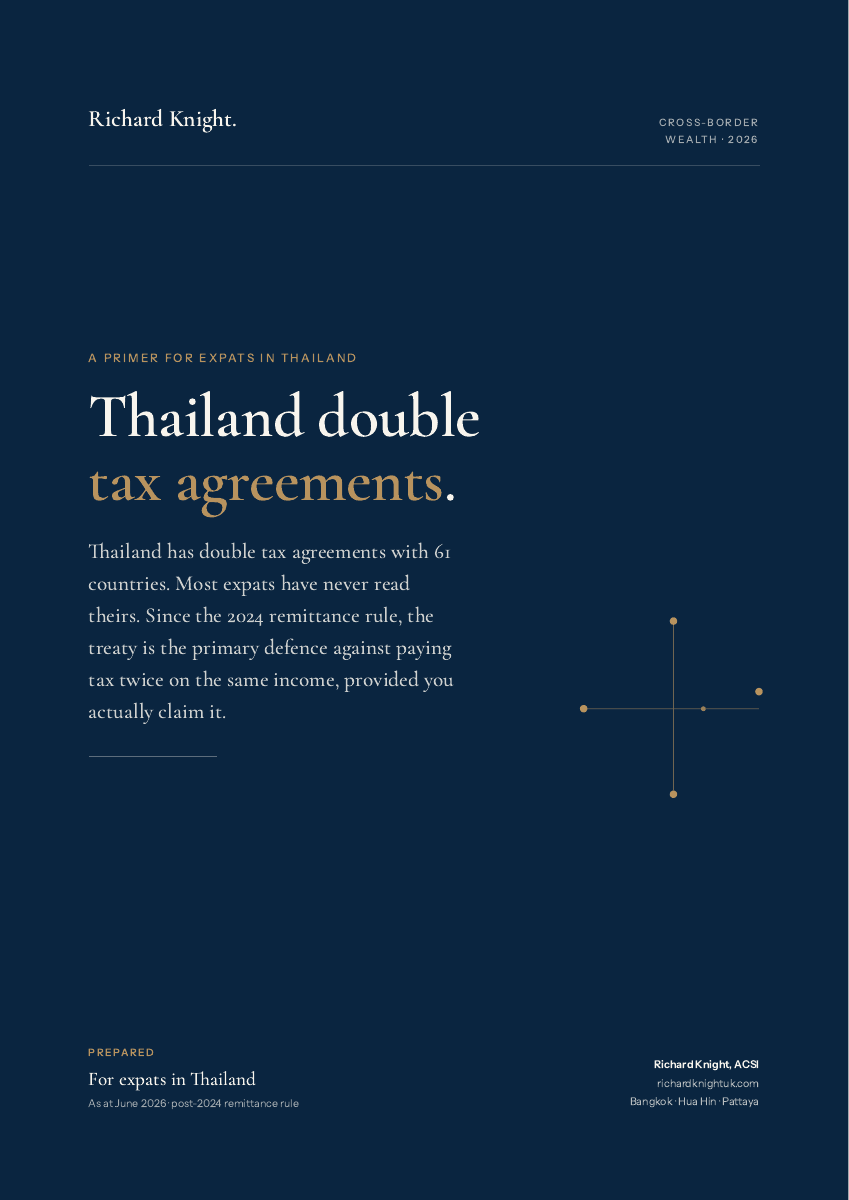
Free guide
Thailand double tax agreements
Thailand has tax treaties with 61 countries. Since the 2024 remittance rule, your treaty is the main defence against paying tax twice, provided you claim it.
What is inside
- What a double tax agreement does, and Thai residence
- The 61-country network, and the key country provisions
- Claiming relief in practice: the Tax ID, the evidence, the PND 90/91
- Credit versus exemption, and which applies to your income
- What treaties do not cover, common mistakes, and the LTR alternative
Plain English, nothing to sign. Useful even if you never get in touch.
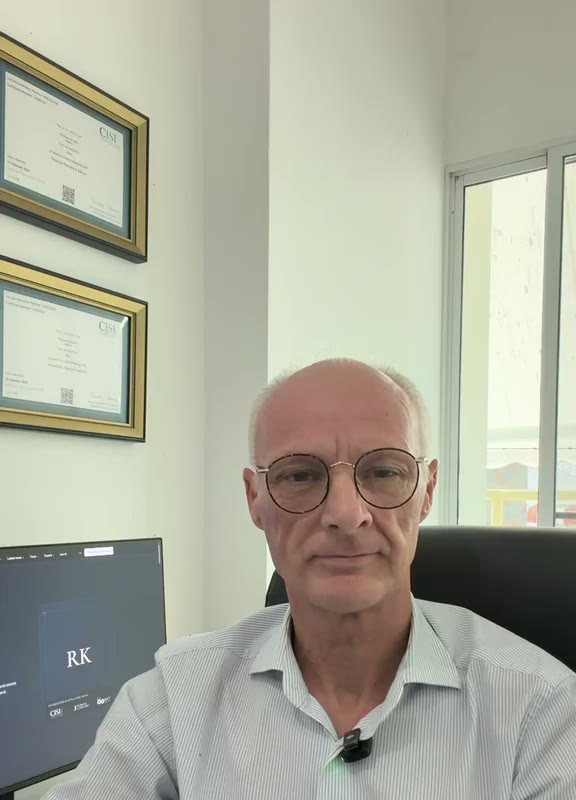
The advisor
Richard Knight
Richard Knight is a British national with fifteen years' experience in private wealth management, advising internationally mobile clients across Asia, Europe and beyond. Based in Thailand, he works with expatriates and international families navigating the complexities of cross-border wealth, retirement and estate planning.
The practice is built on first-hand experience of international relocation and long-term expatriate life, rather than a purely theoretical understanding of it.
He is an Associate Member of the UK's Chartered Institute for Securities & Investment (ACSI) and holds CISI qualifications in Financial Planning and Investments.
He also serves as Vice Chair of the British Chamber of Commerce Thailand in Hua Hin, supporting the local business and expatriate community.
Richard maintains a deliberately limited client base, focusing on conservative, long-term planning for people who value clarity, stability and peace of mind over unnecessary risk.
“Richard works in finance business for many years and his recommendations are reliable and efficient. He is very attentive to the clients and help them to come to the most beneficial solution. Having Richard as your personal finance consultant you can feel secure for your future.”
“Richard is reliable person, with good knowledge of the products that he propose to clients. He want client to understand the process and he cares of the client future.”
“Richard is a great and reliable service provider.”
Fees and what to expect
What it costs, and how I'm paid
I am paid through commission on the products arranged and an ongoing fee on the assets managed. Every cost, and what it pays, is set out in writing before you decide.
You may ask what any recommendation pays me, and the figures that apply are agreed in writing in the engagement letter before you proceed.
A first 30-minute consultation costs nothing and obliges you to nothing.
Client assets are held by an appointed trustee or a regulated platform, never by me.
Questions
Questions about this
Begin a conversation
Thirty minutes, by video or in person at the Bangkok, Hua Hin or Pattaya office. Free, and without obligation. You leave with a clearer view of what is in front of you, whether or not the work proceeds.
Book a meeting
Choose a time that suits you
Thirty minutes with Richard Knight, ACSI directly. By video, phone, or in person. No obligation.